
Unlocking Human Potential
Welcome to the Practical Life Skills Programme website — a shared space that gives recognition to the educators, partners, and communities who make this project possible. This platform belongs to everyone involved. It documents our journey, celebrates progress, and honours the cooperation that has allowed the programme to grow and evolve over the years.
We are a dedicated group of educators and partners united by a common purpose: to empower learners with elementary practical life skills that prepare them for life after school. We believe that every practical skill matters and that, when combined with guidance and opportunity, these skills can help young people become more self-reliant, resilient, and hopeful about their future. Together, as a team, we believe that meaningful change is possible.
Our Partners The Practical Life Skills Programme is built on strong partnerships and shared commitment:
1. A Swiss Charitable Foundation, whose generous support has funded the programme for six consecutive years.
2. The L&S Team, responsible for overall programme management, financial administration, and project mentorship.
3. Regional Directors, who support the programme and, where necessary, actively engage through their regional teams.
4. School Teams, including: School principals, who support and monitor the smooth integration of the programme into the school calendar. School-based coordinators, who implement and manage the project at school level. Community facilitators, who share their practical knowledge and skills with learners and help turn learning into real-life experience. This website proudly documents both the challenges we have faced and the achievements we have reached together.
Our First Objective: Practical Life Skills for Learners
The first objective of the Practical Life Skills Programme is to equip learners with practical, livelihood-oriented skills that complement formal education. Through structured after-school and weekend sessions, learners are introduced to hands-on skills such as food production, basic entrepreneurship, income generation, and problem-solving. These learning experiences are delivered by skilled community facilitators and supported by practical materials, enabling learners to learn by doing. The aim is to strengthen resilience, self-confidence, and future employability, especially for learners who may not progress through purely academic pathways.
Our Second Objective: Training mentoring and certifying Teachers in Applied Project Management
The second objective focuses on building sustainable capacity within schools by training and mentoring teachers as project coordinators in applied project management. Teachers receive targeted training, ongoing mentorship, and practical tools that enable them to plan, implement, monitor, and evaluate the Practical Life Skills Programme at school level. This three-pillar approach of training, mentorship, and assessment strengthens leadership, organisational skills, and accountability, while also providing coordinators with formal recognition and accreditation that supports their professional growth.
By the end of 2020, the scale of the crisis was unmistakable. More than 30,000 Namibian learners did not return to school after lockdowns, and dropout rates rose sharply, particularly among the most vulnerable learners. At the same time, the shift to remote learning revealed severe infrastructure limitations: only about one-third of teachers had reliable internet access, making meaningful online learning inaccessible for the majority of learners, especially in rural areas. It became evident that Namibia was facing one of its most serious educational challenges since Independence. A simple return to “business as usual” was neither possible nor sufficient. Educational inequality was increasing, learning losses were significant, and too many young people were at risk of leaving school without the skills needed to navigate adulthood, employment, or further education.
Three key realities stood out clearly during this period.
First, a growing number of learners were unlikely to complete their schooling with academic results strong enough to access tertiary education. National examination outcomes in the years following COVID-19 reflected this reality, with historically low pass and progression rates. Many learners either left school early or completed their schooling without clear pathways into further training or employment. Without additional, practical skills, large numbers of young people faced exclusion from both the formal and informal economy.
Second, the pandemic highlighted an urgent need for new kinds of skills — not only academic ones. Learners and teachers alike needed to adapt quickly, solve problems creatively, develop resilience, and acquire basic technical and digital competencies. COVID-19 demonstrated that education had to become more flexible, more practical, and more responsive to real-life challenges.
Third, it became clear that schools could not respond to this crisis alone. Communities hold a wealth of practical knowledge — in agriculture, crafts, construction, entrepreneurship, and other livelihood skills. While community members are not trained teachers, they are powerful facilitators of experience-based, informal learning that can meaningfully complement the formal curriculum and reconnect education with daily life.
Out of these reflections, the idea of the Practical Life Skills Programme emerged. The programme was designed to: • equip learners with practical, livelihood-oriented skills, • prepare young people for real-life challenges beyond the classroom, • strengthen resilience in times of uncertainty, and • contribute to long-term poverty reduction. At its core, the Practical Life Skills Programme recognises that education is not only about academic success. It is also about enabling young people to cope, adapt, create opportunities, and take responsibility for their own futures.
What began as a response to crisis has since grown into a structured, multi-year initiative. Now in its sixth year, the Practical Life Skills Programme continues to evolve — shaped by experience, strengthened through partnerships, and guided by the same belief that inspired its creation in 2020: practical skills, combined with mentorship and community involvement, can change lives.
Lloyd Ulrich - Practical Life Skills Programme December 2025
We are a dedicated group of educators and partners united by a common purpose: to empower learners with elementary practical life skills that prepare them for life after school. We believe that every practical skill matters and that, when combined with guidance and opportunity, these skills can help young people become more self-reliant, resilient, and hopeful about their future. Together, as a team, we believe that meaningful change is possible.
The Founding Partnership
This initiative was founded by a small group of committed Namibian education practitioners who share a long-standing belief in practical, life-relevant learning and local ownership of development.
Lloyd Ulrich provides overall direction, continuity, and programme leadership, drawing on decades of hands-on experience in education development, project design, and implementation. Mark Jacobs adds system-level perspective, quality assurance, and governance experience gained through senior roles within the Ministry of Education Paul Fisher contributes deep, practice-based school leadership expertise, rooted in a long and highly successful career as a principal known for integrity, delivery, and keeping commitments.
Together, the three founders complement and strengthen one another. Their partnership blends vision with practice, school-level realities with system-level understanding, and innovation with accountability. This balance ensures that the initiative is credible, well-managed, and firmly grounded in both community needs and national priorities.
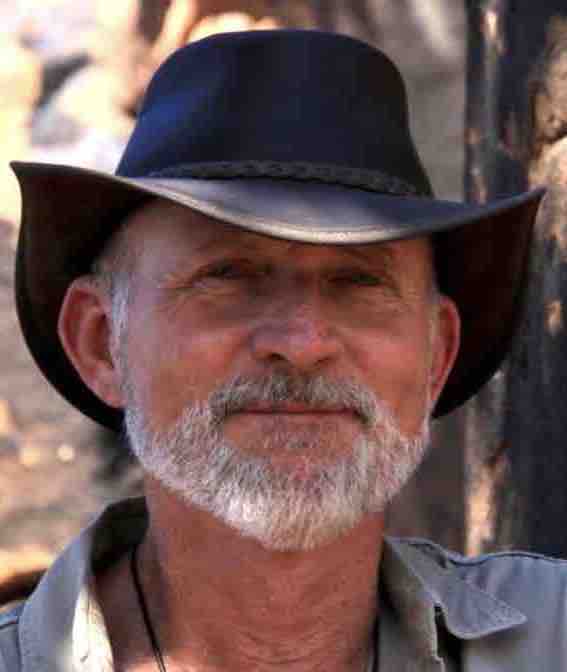
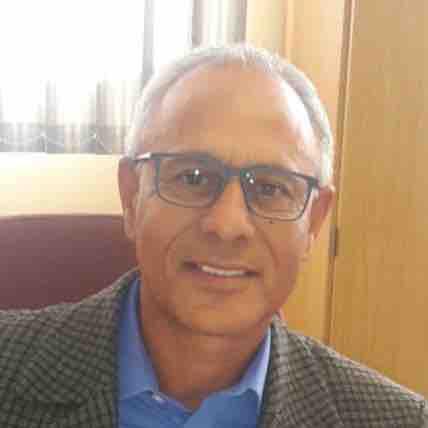
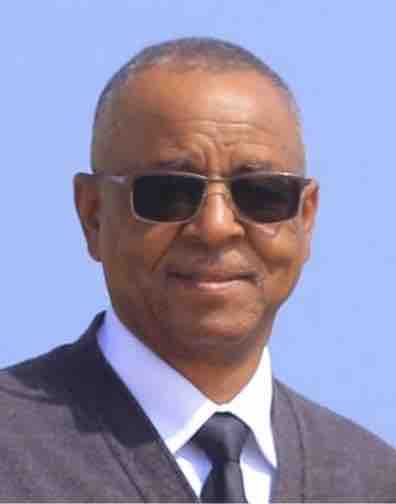
Professional profile: Lloyd Ulrich
Education Leader | Social Development Practitioner | Project Manager | Mentor & Assessor
Lloyd is a Namibian education and social development practitioner with more than 30 years of sustained involvement in the country’s education and skills development sector. He has worked at classroom, school leadership, institutional, and national programme level, and has been directly involved in the design and implementation of education initiatives across Namibia.
His professional journey includes leadership roles in schools, foundations, training institutions, and donor-funded programmes. He has worked closely with the Ministry of Education, the Namibian Training Authority, private foundations, and community-based organisations, always with a strong focus on practical, life-relevant learning.
Lloyd is known for his ability to translate vision into action. He specialises in building programmes that are realistic, well-managed, and responsive to local contexts—programmes that strengthen people, institutions, and communities rather than creating dependency. Within the founding team, he contributes continuity, institutional memory, and deep sector knowledge, ensuring that the programme is grounded in experience, aligned with national priorities, and driven by a genuine belief in human potential.
Professional profile: Mark Jacobs
Mark is a seasoned Namibian education professional with extensive experience at both school and system level. His career spans classroom teaching, subject leadership, regional education management, and senior leadership within the Ministry of Education.
He served for many years as Inspector of Education and later as Deputy Director, where he was responsible for the oversight of educational programmes, curriculum implementation, and quality assurance across the region. In these roles, Mark worked closely with school principals, advisory teachers, and school boards, supporting them to translate national policy into effective teaching and learning practice.
Mark is particularly valued for his strong analytical skills, his depth of knowledge in mathematics and science education, and his calm, structured approach to planning, monitoring, and problem-solving. His experience brings a clear understanding of governance, standards, and accountability within the public education system.
Within the founding team, Mark contributes system-level insight, policy awareness, and quality-assurance expertise, strengthening the initiative’s ability to operate responsibly, coherently, and in alignment with national frameworks.
Professional profile: Paul (Paulus Edward) Fisher
Paul is a highly respected Namibian educator with an exceptional and widely recognised track record in school leadership. He is best known for his long and successful tenure as Principal of Narraville Primary School in Walvis Bay, a role he held from 1995 to 2018.
Over more than three decades in education, Paul earned a reputation for consistent results, integrity, and reliability. As a school leader, he was known not only for improving academic performance and institutional stability, but also for keeping his commitments to learners, staff, parents, and education authorities. His leadership style combined high expectations with fairness, discipline, and genuine care for the school community.
Paul’s career spans classroom teaching, subject leadership, and senior school management. This progression grounded his leadership in practical classroom realities and earned him deep respect among teachers and education officials alike.
Before joining the founding team, Paul was actively involved in the training and mentoring of school principals, with a particular focus on clinical supervision and instructional leadership. He is known for his support to school leaders to strengthen teaching practice, classroom observation, feedback, and instructional improvement, drawing on decades of lived leadership experience rather than theory.
Within the founding team, Paul brings credibility, proven leadership, and a results-driven approach. His long-standing reputation as a principal who delivers on his promises strengthens trust with stakeholders and reinforces the programme’s commitment to accountability and excellence.
Five Years at a Glance
In the five years since its inception during the COVID-19 pandemic, the Practical Life Skills Programme has grown from a pilot initiative into a structured, multi-regional skills programme reaching thousands of learners. Across five consecutive project years:
Schools involved: More than 40 schools across four regions: Erongo, Otjozondjupa, Kunene, and Hardap
Regional partnerships: A successful and ongoing partnership with the Regional Directors of Education in Erongo, Otjozondjupa, Kunene, and Hardap, providing official support, guidance, and alignment with regional education priorities
School-based coordinators trained and mentored: an annual average of 10 coordinators capacitated / mentored in applied project management to plan, implement, and manage the programme at school level
Learners reached: More than 13,000 learners participated in structured Practical Life Skills courses
Courses offered: Several hundred skills courses, ranging from Level 1 introductory skills to advanced Level 3 modules
Total lessons delivered: Well over 7,000 practical lessons, delivered after school hours and on weekends, with all required training materials and consumables provided through the project
Community facilitators engaged: Hundreds of community members trained, supported, and certified as skills facilitators
Additional Highlights
- Continuous implementation without interruption since 2021
- Certification issued to learners, facilitators, and coordinators
- Progressive development from single skills to multi-level learning pathways
- Introduction of food production and income-generation as core poverty-reduction themes
- Ongoing mentorship as a cornerstone of quality and sustainability
Executive Summary - 2021
The Practical Life Skills Project was designed to provide up to 1,152 learners from 12 schools in the Erongo and Kunene Regions with access to practical, hands-on life skills training delivered by suitably experienced community members. Although two schools were ultimately unable to participate, the project successfully reached 1,200 learners across 10 schools, exceeding its original target.
The outbreak of the COVID-19 pandemic and the resulting national and local lockdowns significantly disrupted the project timeline. It was not possible to complete the programme within the initially planned period, and repeated interruptions led to changes in learner participation. In particular, some senior learners disengaged as they shifted focus to national examinations. Each lockdown required programme adaptations at school level, often involving new facilitators and revised skills offerings.
Throughout this period, the L&S consulting team continuously redirected its core resources—time, funding, and manpower—to ensure continuity and relevance. All decisions were guided by three central considerations:
1. Whether changes would remain beneficial to learners and allow the L&S consulting team (Mr L. Ulrich, Mr M. Jacobs, and Mr P. Fisher) to uphold its educational commitment to partners;
3. Whether available funding could support ongoing adjustments, made possible through the generous and flexible support of the Swiss Charitable Foundation. A key factor in the project’s success was the commitment of school-based coordinators at each of the 10 partner schools. It became evident that their effectiveness was closely linked to the active support of their school principals. Where strong leadership existed, the programme flourished.
While formal schooling is designed to guide learners through a structured academic progression, the Practical Life Skills Project successfully complemented this process. In a year when education systems were under unprecedented strain, the project extended learning opportunities beyond the classroom, adapting to changing conditions and providing meaningful, applied learning experiences to 1,200 learners.
The project team expresses sincere gratitude to all partners—including the Ministry of Education, Arts and Culture, participating schools, local communities, and the Swiss Charitable Foundation—whose collaboration made this initiative possible. Building on the lessons learned, the project partners remain hopeful that the programme can continue into a second year, further strengthened through smart public-private partnerships for the benefit of learners in 2022
Executive Summary
The year 2022 marked the second year of implementation of the Practical Life Skills Project (PLSP). While the primary challenge in 2021 was to determine whether community members could successfully deliver practical skills training within selected schools, the focus in 2022 shifted towards expansion, consolidation, and capacity building.
Following consultative meetings with the Regional Directors of the Erongo and Kunene Education Regions, the project set out not only to repeat but significantly expand on the 2021 achievement of reaching 1,200 learners. In addition, and at the request of the Regional Directors, the project incorporated a structured capacity-building component for school staff, with particular emphasis on empowering school-based coordinators to drive all school-level activities.
Inspired by the Namibian Training Authority’s portfolio-based assessment approach, the project adopted a three-pillar strategy consisting of training, mentorship, and accreditation. School coordinators were trained in project management, mentored over an extended period, and required to compile portfolios of evidence documenting their knowledge, skills, and experience. Upon completion, these portfolios were formally assessed, leading to official regional accreditation in project management skills.
Within the parameters of the approved project proposal and budget, the following outcomes were achieved in 2022:
- 220 school community members were recruited and collectively delivered 1,752 practical lessons, conducted in the afternoons and over weekends.
- 3,000 learners from 11 schools attended and completed an eight-session Practical Life Skills course.
- All learners who completed the full course received official certificates confirming full attendance.
- Specialised entrepreneurship training materials were developed, and 277 learners from 11 schools received applied entrepreneurship training.
- A project management seminar focused on improving educational outcomes was developed and delivered.
- Relevant project management tools were developed, and 12 coordinators were trained in their application and associated management skills.
- 11 coordinators completed an eight-month mentorship programme, submitted portfolios of evidence, and were awarded certificates of competence in line with their individual performance.
The 2022 implementation of the Practical Life Skills Project demonstrates that, through targeted capacity building, mentorship, and structured accountability, schools can significantly expand access to practical learning opportunities. The project not only increased the number of learners reached but also strengthened local ownership and sustainability through empowered school-based leadership.
For the third consecutive year, the Practical Life Skills Project (PLSP) received generous funding from the Swiss Charitable Foundation, enabling the continuation and further expansion of the programme in 2023.
Following consultative meetings with project partners in the Kunene and Erongo Regions, the PLSP continued its work with both learners and school-based coordinators across the two regions. As in previous years, the primary objective was to sustain the programme while deliberately expanding its reach to new schools and their communities. Building on the success of the previous two years, the project assumed that it would again be possible to recruit, motivate, capacitate, and mentor school-based coordinators to independently drive implementation at school level. A secondary objective remained the continued capacity building and regional accreditation of newly appointed coordinators in the field of applied project management.
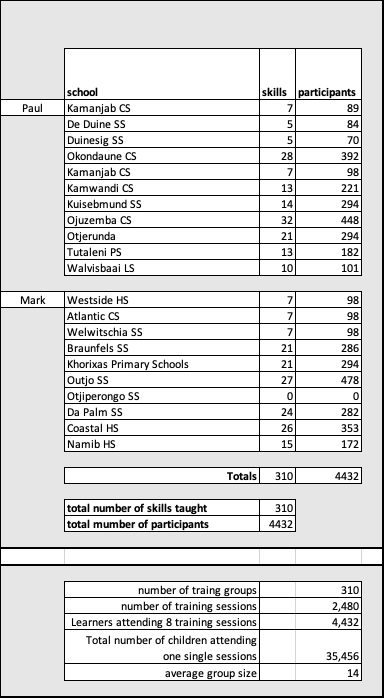
Within the parameters of the approved project proposal and budget, the following outcomes were achieved in 2023:
- 310 school community members (up from 220 in 2022) were recruited and each received a financial token of appreciation for every course presented.
- A total of 2,480 practical lessons were delivered (up from 1,760 in 2022), conducted in the afternoons and/or over weekends.
- 4,432 learners (up from 3,277 in 2022) attended and completed an eight-session Practical Life Skills course.
- All required consumables for the 4,432 learners were funded through the project.
- 4,432 certificates for successful course completion were printed and signed for learners who attended all eight sessions of their chosen course.
- 22 schools participated across the different project cycles, of which 14 schools were new to the programme. In Khorixas, three schools were grouped together and supported under the leadership of an experienced coordinator.
- 14 coordinators were trained or retrained in project management. Coordinators from the 2022 cohort required no introductory training and were able to commence implementation immediately.
- Relevant project management tools were adapted, and coordinators were trained in their application, along with all associated project management skills.
- 11 new coordinators (the same number as in 2022) were mentored over an eight-month period, compiled portfolios of evidence, and were all awarded certificates of competence reflecting their individual performance.
Executive Summary
For the fourth consecutive year, the Practical Life Skills Project (PLSP) received generous funding from the Swiss Charitable Foundation, enabling the continuation and further development of the programme.
Following consultative meetings with partners and stakeholders in the Kunene, Erongo, and Otjozondjupa Regions, the PLSP continued and expanded its programmes for learners and school-based coordinators at selected schools across these regions.
As in previous years, the primary objective remained the reduction of future poverty through practical skills development. To achieve this, the project reached both existing and new schools and their surrounding communities. The implementation process focused on recruiting, motivating, and capacitating new and returning school-based coordinators, who in turn engaged skilled community facilitators. These facilitators delivered structured, introductory practical life skills training to learners.
A secondary objective was the continued capacity building and regional accreditation of newly appointed local coordinators in the field of applied project management.
Within the parameters of the approved project proposal and budget, the following was achieved in 2024:
16 schools participated across the different project cycles, of which 10 schools were new to the programme. In Khorixas, three primary schools were grouped under the leadership of a newly appointed coordinator.
14 school-based teachers were recruited to serve as project coordinators.
All coordinators were trained or retrained and continuously mentored in applied project management.
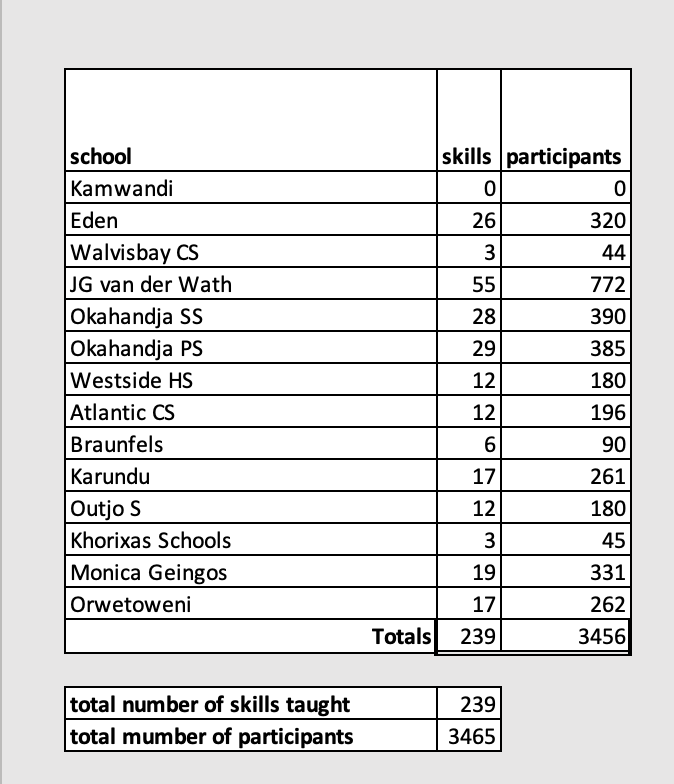
Through the coordinators, 239 school community members were recruited to facilitate practical life skills courses. Each facilitator received a certificate for every course presented.
A total of 1,912 individual practical lessons were delivered in the afternoons and/or over weekends, with an average group size of 14.5 learners.
3,465 learners attended and completed an eight-session Practical Life Skills course.
All training consumables for the 3,465 learners were funded through the project.
3,465 learner certificates for successful course completion were printed and signed for learners who attended all eight sessions of their chosen course.
All existing project management tools for school-based implementation were adapted, and coordinators were trained in small groups in their use, along with all associated project management skills.
All coordinators were mentored over an eight-month period and submitted portfolios of evidence for accreditation in applied project management.
11 new coordinators were awarded certificates of competence reflecting their individual performance.
In preparation for future programme development, a Level 2 Practical Life Skills programme was trialled at four selected schools in 2025 by experienced coordinators.
Towards the end of 2024, and based on stakeholder feedback, a growing need for certified pre-apprenticeship training was identified. In response, a Level 3 programme was developed and trialled to certify the acquisition of clearly defined skills.
Facilitators and coordinators received a pro-rata financial token of appreciation for the services rendered to the project.
The 2024 implementation further demonstrates the PLSP’s ability to adapt, expand, and deepen its impact while maintaining strong local ownership, accountability, and a clear focus on sustainable skills development.
Executive Summary
In 2025, the Practical Life Skills Project (PLSP) was implemented for its fifth consecutive year, made possible through the continued generous support of the Swiss Charitable Foundation. In line with the strategic planning undertaken in 2024 and following consultative sessions with project partners, the programme continued in the Erongo Region (three schools in Swakopmund), the Otjozondjupa Region (four schools in Okahandja and two schools in Otjiwarongo), and the Kunene Region (one school in Outjo). In addition, the PLSP was expanded to include three schools in Rehoboth in the Hardap Region.
As in previous years, the primary objective remained the reduction of future poverty through practical skills development. The project continued to engage both existing and new schools and their surrounding communities. The 2025 implementation was characterised by a stronger emphasis on quality assurance, improved training tools, restructured mentorship approaches, and the development of new learning materials, including Level 3 manuals and readers. The introduction of knowledge assessments and strengthened administrative processes further enhanced the credibility, reliability, and long-term sustainability of the PLSP.
A second central objective remained the capacity building and accreditation of school-based coordinators in applied project management, implemented through the established three-pillar approach of training, mentorship, and assessment.
Within the parameters of the approved project proposal and associated budget, the following outcomes were achieved in 2025:
· The project continued in the Erongo, Otjozondjupa, and Kunene Regions and was extended to schools in the Hardap Region.
· Planning and assessment meetings were held with regional directors in two regions.
· 13 schools participated across the different project cycles, of which nine were new to the programme.
· 13 school-based teachers were recruited to serve as project coordinators.
· All coordinators were trained or retrained and continuously mentored in applied project management.
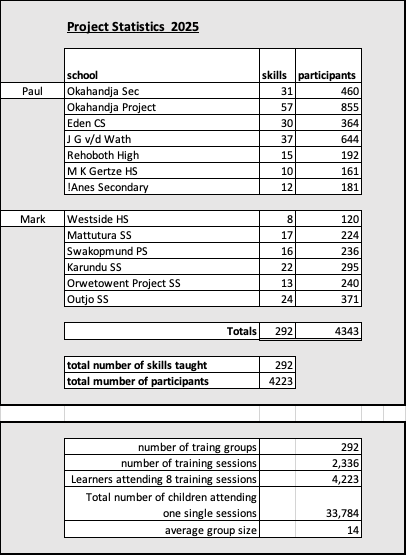
· Through the coordinators, 292 school community members were recruited to facilitate practical life skills courses, with each facilitator receiving a certificate for every course presented.
· A total of 2,336 individual practical lessons were delivered in the afternoons and/or over weekends, with an average group size of 14 learners.
· 4,223 learners attended and completed an eight-session Practical Life Skills course.
· All training consumables for the 4,223 learners were funded through the project.
· 4,223 learner certificates for successful course completion were printed and signed for learners who attended all eight sessions of their chosen course.
· A training and alignment weekend for coordinators was held at Ijaba Lodge near Outjo.
· All existing project management tools for school-based implementation were reviewed, adapted, and explained, and coordinators were trained in their use.
· All coordinators were mentored over an eight-month period. The nine new coordinators submitted portfolios of evidence and were accredited in applied project management.
· The nine new coordinators were issued certificates of competence reflecting their individual performance.
· Twelve Elementary Level 3 training manuals, including structured knowledge assessment sections, were developed.
· Food production, specifically potato planting, was introduced at most participating schools.
· A new income-generation module focusing on selling was developed and successfully trialled during Level 3 cycles.
· Individual mentorship sessions were increasingly replaced by longer group sessions, strengthening peer learning while reducing implementation costs.
· All 292 facilitators and the 13 coordinators received a pro-rata financial token of appreciation for their services to the project.
The 2025 project year reflects a deliberate shift from expansion to quality consolidation, reinforcing the PLSP as a credible, scalable, and sustainable model for practical skills development and school-based capacity building
...........
THE ROLE OF THE SCHOOL-BASED COORDINATOR (Practical Life Skills Project – PLSP)
The school-based coordinator is responsible for the local implementation and management of the Practical Life Skills Project (PLSP) at school level. Throughout the project, the coordinator is mentored and supported by an L&S mentor. Upon successful completion of the project and submission of a complete project management portfolio, the coordinator will be assessed and may receive an official certificate of competence, signed by the Regional Office.
Downloads